The
Morning
Brief
Monday, June 15, 2026
Today's Signal
Today's content clusters around a central tension: AI is compressing the distance between design intent and working software, while simultaneously demanding new disciplines — loop control, memory architecture, multi-agent coordination — that didn't exist in the designer's toolkit two years ago. Underneath that sits a quieter structural shift: the tools are becoming more capable faster than most teams can govern them, raising questions about oversight, craft, and what 'doing the work' even means when agents are running in parallel.
Deep Read
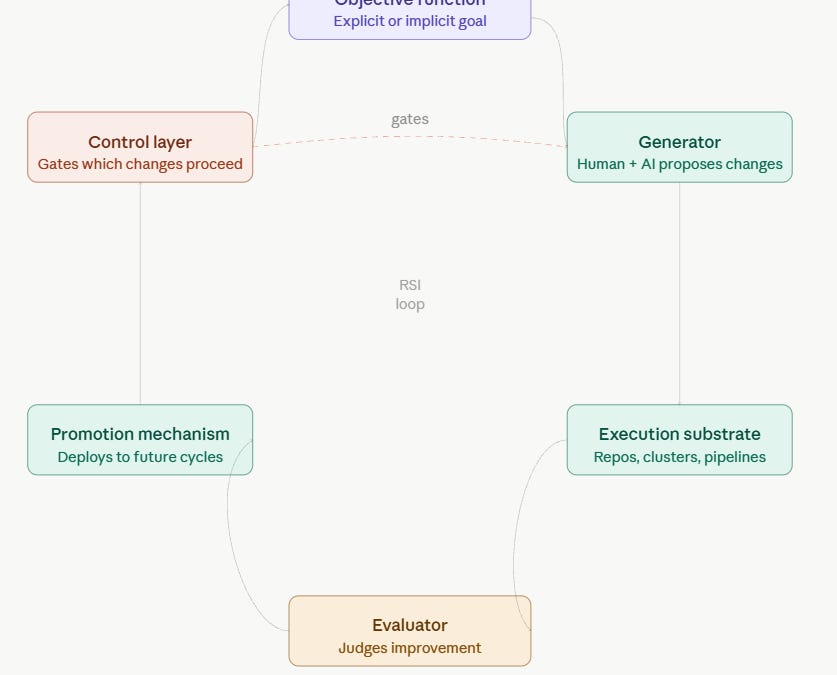
AI Is Already Helping Build Its Own Successors — The Real Question Is Who's Watching
Agentic AI
Recursive self-improvement isn't a sci-fi premise anymore — it's an engineering decomposition problem. AI systems are actively accelerating discrete parts of their own development pipeline: writing code, running experiments, evaluating outputs, and staging deployments. The genuinely urgent question isn't whether full autonomous self-improvement is here, but whether the pace of AI-generated work has already outrun the human review capacity needed to catch what goes wrong.
In the Feed
When PMs and Designers Push Directly to Code, What Happens to the Operating Model?
Lenny's Newsletter
AI adoption isn't just speeding up product teams — it's dissolving traditional role boundaries, with designers and PMs increasingly making changes that previously required engineering handoffs. The structural implications for how product orgs are built, governed, and held accountable are only beginning to surface.
The 'Loopmaxxing' Trap: Why Autonomous AI Workflows Need Hard Exits, Not Open Iteration
AlphaSignal
Designing agentic workflows isn't just prompt engineering — it's control-flow architecture. Without explicit retry limits, validation checkpoints, and deterministic exit conditions, autonomous loops can spiral into token-burning, unmaintainable messes. The discipline of loop engineering is emerging as a craft concern, not just a cost one.
Five Parallel Agents, One Feature: Task Parallelization Is Rewriting How Work Gets Done
The Founders Corner
Rather than a single AI assistant moving sequentially through architecture, implementation, testing, and review, multi-agent parallelization matches the right model to each subtask simultaneously — compressing timelines in ways that change what 'a day's work' means for any knowledge worker.
Quick Takes
AI 'dreaming' — asynchronous memory consolidation between sessions — is becoming a production primitive, not a metaphor, and it has direct implications for any design tool that claims persistent context across workflows.
Agentic AI →App creation exploding while usage stays flat is the clearest proof yet that AI lowers the cost of making things without solving the harder problem of making things people actually want.
The Founders Corner →A browser-native element selection tool built with Claude Code signals that the Figma-to-code gap may be closing not from the design side but from the implementation side up.
Substack →The shift from feature-based to price-based differentiation in AI subscriptions suggests the tooling layer is commoditizing faster than anyone expected, which puts the premium back on how designers use these tools, not which ones they choose.
The Founders Corner