The
Morning
Brief
Thursday, September 10, 2026
Today's Signal
Today's content sits at a charged intersection: AI systems are now solving century-old mathematical problems and competing in data science tournaments, while simultaneously reshaping how humans learn, reason, and make decisions. For designers specifically, the question underneath all of it is the same — as AI absorbs more cognitive labor, what does the distinctly human contribution become, and how do we build systems and workflows that preserve rather than erode that judgment?
Deep Read
The First 'Critical-Tier' AI: What It Means When a Model Reasons in Latent Space
Agentic AI
OpenAI's Astra has crossed a threshold no model has before — rated Critical-tier for autonomous cybersecurity capabilities, including zero-day exploit generation. More striking for design and creative systems thinkers: the model's recurrent-depth reasoning operates partly in latent space, meaning its chain of thought is no longer fully visible in token sequences. This interpretability gap raises a structural question that will soon land in every design system governance conversation — how do you audit, trust, or build on top of a system whose reasoning you can't inspect?
In the Feed
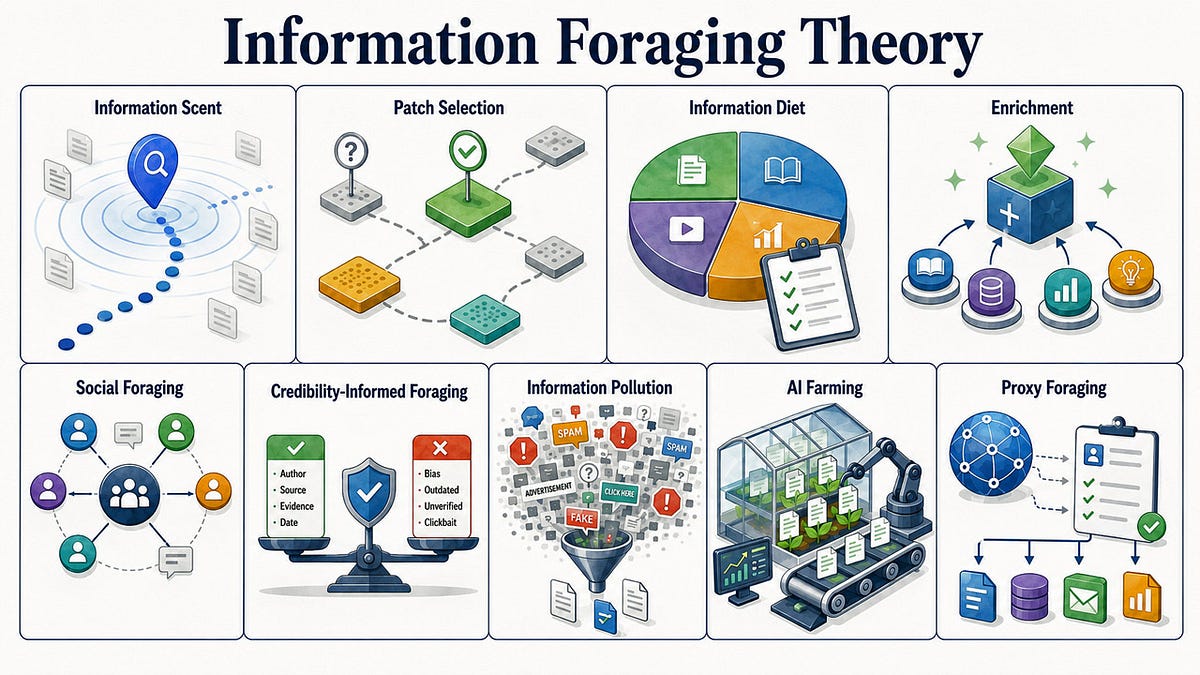
Information Foraging in the AI Era: Why the Hunting Model Still Explains How People Seek Value
Jakob Nielsen
Applying biological foraging theory to three generations of the web reveals a durable truth: people optimize for value-per-second, not comprehensiveness. As generative AI becomes the new information patch, the design implications shift dramatically — the scent trail is now a conversation, and the cost of abandonment drops to nearly zero.

Does AI Actually Change How You Think? Researchers Disagree — and That Gap Matters
Slow AI
A research dialogue surfaces real uncertainty about whether AI use causes learner passivity or merely correlates with it — and proposes concrete interventions (reasoning before AI, then after) to keep human judgment active. The implications extend well beyond classrooms: any workflow where AI generates the first draft may be quietly eroding the independent thinking it appears to augment.
Fake Consensus Is a Design Problem: Three Hidden Disagreements Per Meeting, on Average
Jakob Nielsen's UX Roundup
Research shows teams routinely mistake surface agreement for alignment, with nearly three buried disagreements per meeting going unaddressed. The finding has direct implications for design crits, systems governance reviews, and any collaborative decision process — and AI-assisted structured questioning may be more effective at surfacing gaps than open discussion alone.
Quick Takes
When Claude formalizes Fermat's Last Theorem in 13 million lines of verified code in under two weeks, the honest design question is no longer 'can AI do complex reasoning work' — it's 'what work are we actually protecting by keeping humans in the loop?'
AlphaSignalThe sunk cost fallacy is as much a design team failure mode as a user one — shipping a bad system because six months went into it is the same trap as staying in a bad product because you've already paid.
Jakob Nielsen's UX Roundup →Cursor's self-hosted cloud agents — where only planning logic leaves the building — is the architecture pattern that will finally make AI coding tools viable for enterprise design systems teams with strict data residency requirements.
AlphaSignalA validated 17-question survey measuring six distinct AI attitude factors — including dependency and personification — is exactly the kind of measurement instrument design teams need before rolling out AI tools to broader orgs, not after.
Jakob Nielsen's UX Roundup →