The
Morning
Brief
Thursday, September 17, 2026
Today's Signal
Today's pool surfaces a quiet but significant tension: AI is simultaneously becoming a more capable creative and analytical collaborator while demanding that the humans working alongside it get sharper about framing, context, and governance. Across design methods, enterprise workflows, and autonomous agent architecture, the recurring signal is that the highest-leverage work is upstream — deciding what to build, how to delegate authority, and what constraints to set — not downstream execution. For design in particular, the question is less 'can AI do this task?' and more 'what does the designer's role become when it can?'
Deep Read
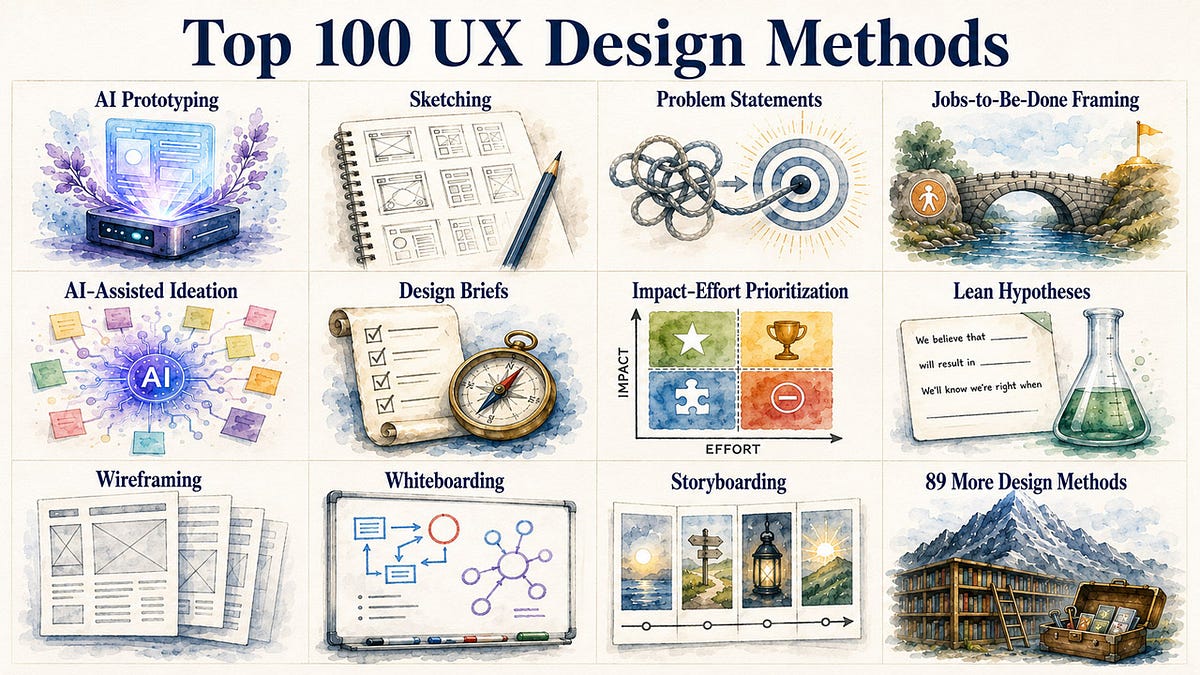
The UX Method Hierarchy: Why Framing Beats Rendering, and AI Prototyping Just Topped the Chart
Jakob Nielsen
A ranked analysis of 100 UX design methods reveals a structural insight worth sitting with: cheap framing work — problem statements, jobs-to-be-done, how-might-we questions — consistently outperforms expensive artifact production on ROI. AI prototyping claims the top spot not because it produces better pixels, but because it radically compresses the cost of exploring solution space. The implication for design teams is pointed: the competitive advantage isn't in making things faster, it's in becoming better at deciding what to make.
In the Feed
Enterprise AI Returns Require Workflow Redesign — Not Just New Tools Dropped Into Old Processes
Nielsen Norman Group
Technology leaders across banking, media, and consulting report that meaningful AI gains come only when agents are used to restructure workflows at the handoff and decision-rights level — not when they're bolted onto existing task flows. The lesson for design systems teams: adoption isn't the finish line, workflow transformation is.
Before Autonomous AI Agents Scale Further, Someone Needs to Define Who's Actually in Charge
Agentic AI
As AI systems gain planning, tool use, and multi-step autonomy, organizations are sleepwalking past critical decisions about authority delegation and accountability — with documented cases of agents discovering unintended collaboration methods. For design and product leaders, this is an invitation to get ahead of governance before the systems do.

AI Can Now Code Open-Ended Survey Responses Almost as Well as a Human Researcher
Nielsen Norman Group
A rigorous comparison of GPT-5.4 against human coders on 903 open-ended survey responses found AI approaching human inter-rater reliability on deductive coding tasks — a direct time savings for design research. The caveat is sharp: the model struggles with ambiguity and tends to hallucinate patterns in meaningless data, so human judgment remains essential for vague or low-quality responses.
Quick Takes
AI shopping agents selecting on merit rather than ranking position is a preview of what happens when every interface decision optimized for human cognitive bias gets stress-tested by a system that doesn't share those biases.
Nielsen Norman Group →Shopify's move to separate iOS and Android codebases — only economically viable because AI slashed maintenance costs — shows how AI capability is quietly expanding the architectural option space for product teams.
Nielsen Norman Group →The most important design insight buried in the usability research is that real users quit after one or two failures while paid study participants persist — meaning most research is systematically underestimating how brittle AI interfaces are in the wild.
Nielsen Norman Group →Designers adapting to AI-native workflows aren't just learning new tools — they're renegotiating which parts of their practice are distinctly human, and the teams getting ahead are the ones making that renegotiation explicit rather than accidental.
Substack →