The
Morning
Brief
Thursday, October 8, 2026
Today's Signal
Today's content circles a central tension: AI is rapidly becoming infrastructure rather than novelty, pushing both tools and creative work toward questions of system-level design rather than individual output. Meanwhile, classic design craft principles—progressive disclosure, attention economy, expectation management—remain stubbornly durable even as the medium shifts. The implication for designers is that the highest-leverage work lives at the intersection: designing the systems, tokens, and pipelines that give AI-assisted creation its shape and constraints.
Deep Read
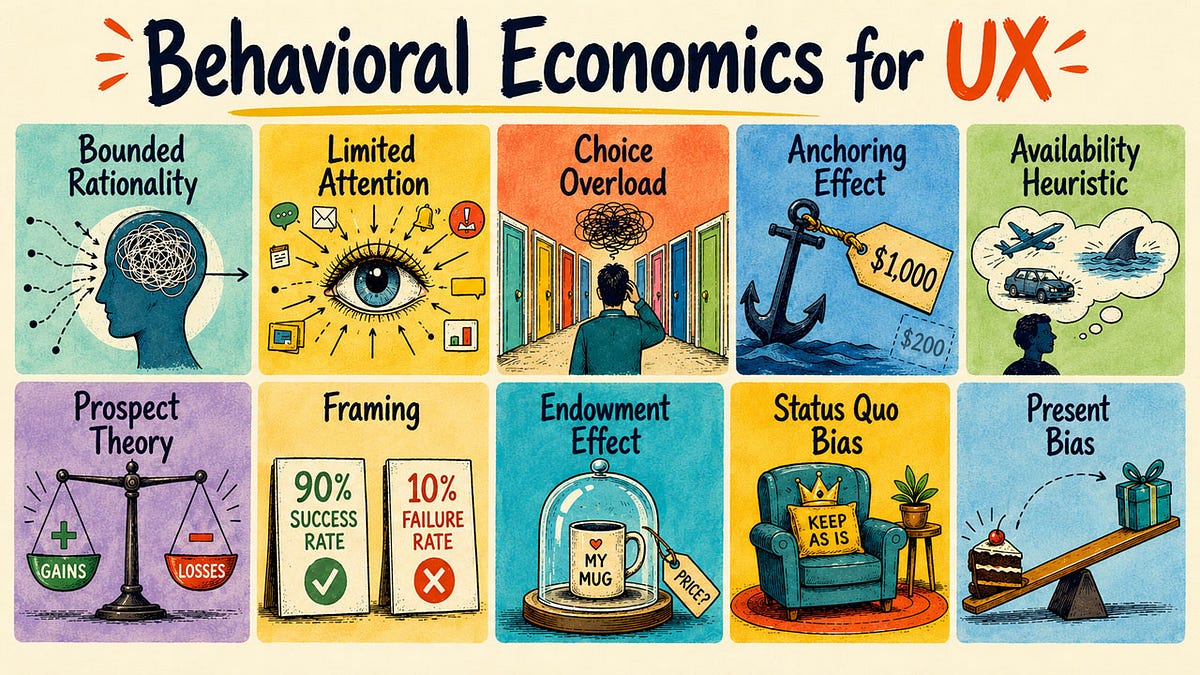
50 Design Guidelines Rooted in How Human Brains Actually Decide
Jakob Nielsen
Humans don't evaluate interfaces rationally—they apply survival-era heuristics to modern UIs, and three Nobel Prize–winning findings explain most of the resulting misfires: loss aversion, bounded rationality, and the outsized collective power of small nudges. This guide translates behavioral economics into 50 actionable design guidelines, making the case that understanding cognitive shortcuts isn't a soft skill but a structural requirement for designing systems that actually work at scale.
In the Feed
Claude Code Gets a Mod System — and It Looks a Lot Like a Design System for AI Behavior
AlphaSignal
Developers can now write TypeScript plugins that hook directly into Claude Code's agent loop, creating custom UI and behavioral overrides—including a 'Blast Radius' interceptor for risky commands and a context-window monitor. It's the earliest signal that AI coding tools are evolving toward extensible, governed platforms rather than monolithic black boxes.

AI Isn't Plateauing — It's Entering a Phase of Radical Cost Deflation
Ruben Hassid
The argument that AI is a bubble collapses under four simultaneous signals: business adoption at 50%, spending quadrupling year-over-year, continued model improvement, and an 79× drop in capability cost in a single year. The structural consequence isn't slower adoption — it's that the economic floor for cognitive tasks is approaching zero, which reshapes which creative and analytical skills retain premium value.

Small Design Teams Win by Refusing to Generate 'Work Around the Work'
Design Better
Intentionally constrained design teams—where designers can ship directly to production and hierarchy is kept flat—tend to focus on craft quality across every touchpoint rather than getting absorbed in coordination overhead. The insight is structural: team size itself is a design decision with downstream consequences for the quality and velocity of output.
Quick Takes
When AI can turn a single photograph into a physics-enabled, audio-populated 3D world in five minutes, the creative bottleneck has officially moved from production to direction — knowing what to make, not how to make it.
AlphaSignalSatisfaction is a gap metric, not an absolute one — a design that perfectly matches user expectations always outperforms a technically superior design that overpromised.
Jakob Nielsen's UX RoundupClaude Code's new scheduled routines — running autonomously on a timer, triggering on Git events, delivering to Slack — mark the moment AI coding assistants stop being reactive tools and start behaving like persistent, unsupervised collaborators.
System Design One →The proliferation of sparse-activation open models — Mistral at 1T params with 49B active, Beam at 501B with 23B active, Kolibri at 78B with 3.5B active — suggests frontier-quality AI capability is commoditizing faster than any single closed provider can sustain as a moat.
AlphaSignal