The
Morning
Brief
Tuesday, October 20, 2026
Today's Signal
Today's content circles a central tension: AI is rapidly democratizing execution — in design, tutoring, legal work, and creative production — while human judgment remains the irreplaceable bottleneck at the finish line. Designers, in particular, are watching their skill advantage compress as non-designers close the gap with AI-assisted tools, which reframes the design role from making to deciding. The question isn't whether AI accelerates the work, but whether the mental models guiding that acceleration are sound enough to trust at speed.
Deep Read
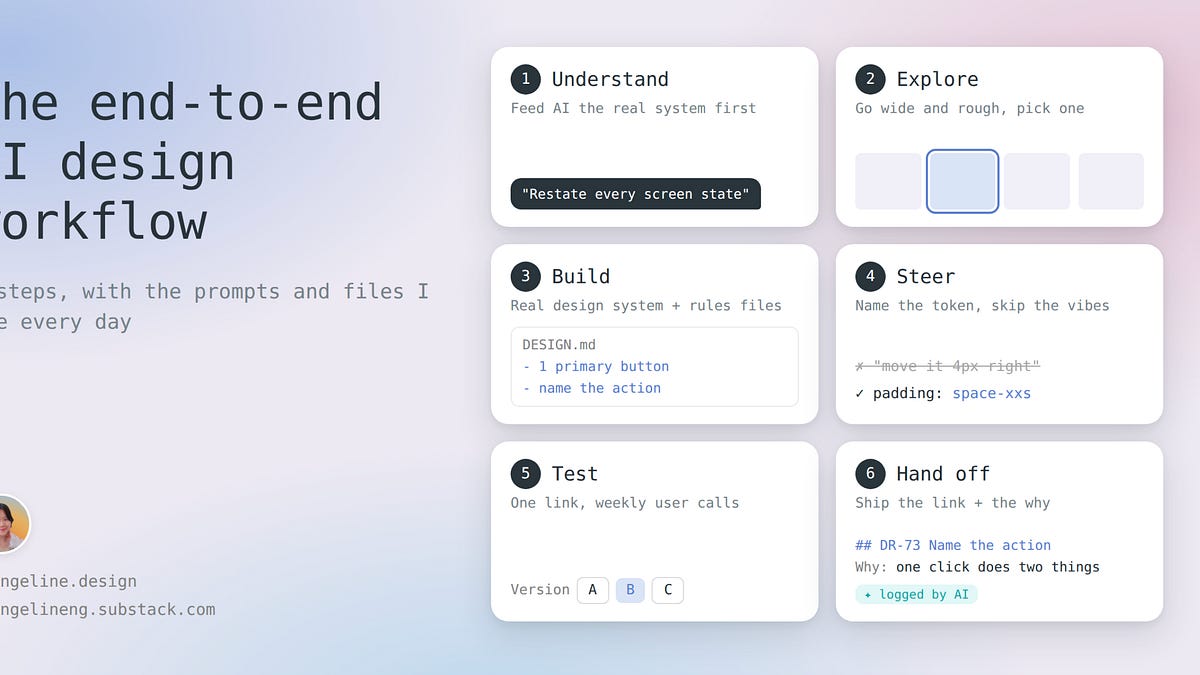
The AI Design Workflow That Actually Ships: Six Stages, Real Prompts, Tested in Production
AI-Native Designers Garden
This isn't a theoretical framework — it's a battle-tested six-stage process for designing with AI from brief to handoff, built on three months of shipping real features. The key structural insight is that AI must receive system context first (via MCPs), variants should be explored at low fidelity before any refinement begins, and handoff requires decision logs not just deliverables. For design systems practitioners especially, the emphasis on building within existing systems rather than around them is the discipline that separates sustainable AI-assisted design from beautiful one-offs.
In the Feed

AI Narrows the Designer–PM Skill Gap by 70% — and That Changes Everything About the Job
Nielsen Norman Group
A controlled trial found AI tools helped non-designers close the execution gap with experienced designers dramatically, shifting design's value proposition from craft output to judgment about which output to ship. The uncomfortable implication: the more AI handles production, the more the design role looks like curation and decision-making rather than making.
Designers Trust AI to Explore, Not to Finish — and the Data Backs That Instinct
Nielsen Norman Group
Across 443 designers globally, AI adoption peaks at ideation and drops sharply at delivery, revealing a professional consensus: AI is a divergence engine, not a convergence tool. Early-stage errors are cheap; late-stage errors ship to customers — and designers know the difference.
AI Accelerates Every Stage of Decision-Making — But the Orientation Step Is the Landmine
Nielsen Norman Group
Boyd's OODA loop reframed for the AI era reveals that speed is not the primary advantage — accurate mental models are. AI can compress weeks of synthesis into minutes, but if the orientation stage produces corrupted understanding, acting faster just means failing faster. The discipline of slowing down to verify the model is more valuable than any speed gain.
Quick Takes
AI tutors now match expert human tutors in learning outcomes at 1/918th the cost — but only when they teach rather than just answer, a distinction that should reshape how designers think about AI-assisted onboarding in their own products.
Nielsen Norman Group →Meta's Muse Wonder model is strong for multi-step agentic tasks but consistently fails at frontend design work, defaulting to generic layouts and losing visual polish — a useful reality check for anyone evaluating AI tools for design system generation.
Lenny's Newsletter →Teaching AI to replicate a specific creative style requires deep craft knowledge — timing, pacing, rhythm — and persistent system-level memory, not one-off prompts; the model is only as good as the creative framework you've built around it.
Lenny's Newsletter →The top 10% of AI power users send 63% of all prompts while the median conversation remains frozen at two exchanges — suggesting that most people are still treating AI as a search engine, not a collaborator, and the productivity gap between power users and casual users will only widen.
Jakob Nielsen →