The
Morning
Brief
Monday, November 16, 2026
Today's Signal
AI is restructuring not just what designers make, but the organizational conditions under which they make it — flattening teams, shifting human value toward judgment and specification, and moving the design artifact itself from pixel to parameter. Across today's content, a consistent pressure emerges: as AI handles generation at scale, the human role collapses upward into goal-setting, governance, and triage. Design systems thinking — structured tokens, explicit rules, defined interfaces — turns out to be exactly the right mental model for this transition.
Deep Read
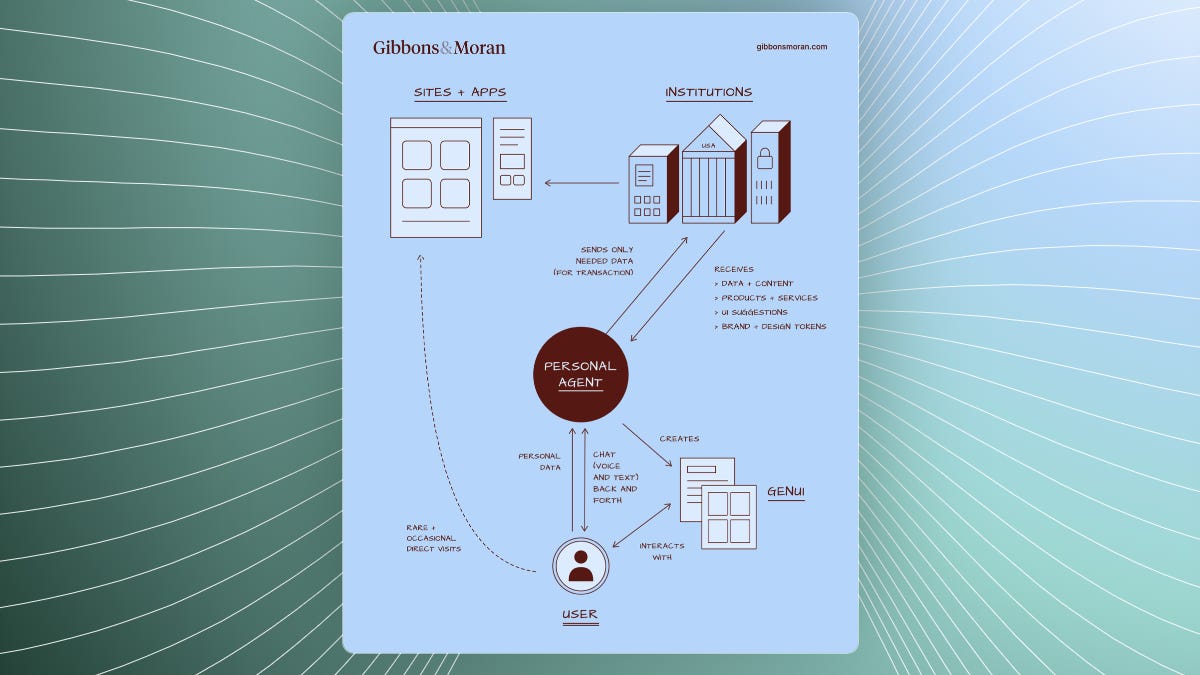
When Agents Browse for Us: Design Systems Are the New Interface
Jakob Nielsen
As AI agents increasingly transact on users' behalf, the designed screen may cease to be the primary touchpoint entirely — reducing direct human web visits to occasional exceptions. The designer's role shifts from crafting persuasive journeys to authoring structured data hints (design tokens, intent signals) that agents interpret to construct individualized interfaces. The organizations that begin this transition now have a decade-long head start; those that wait will find the transformation has already happened to them.
In the Feed

Design Teams Are Being Pancaked: Thinner, Broader, and Redefined by 2030
Jakob Nielsen
AI is collapsing design org charts into smaller pods with fused roles, hollowing out junior-level entry points, and shifting the designer's core job from making interfaces to defining the goals and rules by which AI generates them. The org chart is only now catching up to workflows that have already changed.

Human Attention Is the New Bottleneck: What Happens When Agents Outwork Us Six-to-One
Jakob Nielsen
At the frontier of AI-integrated work, agents already log six hours for every human hour — yet spend 80% of that time idle, waiting for human input. The implication is a fundamental reorientation of hiring toward judgment and autonomy, and the emergence of a new category of meta-work: writing agent specs and reviewing agent output.

AI Makes Output Free — Reading Still Costs Attention
Jakob Nielsen
Two studies show that capping AI questions at 1–3 reduced user attention cost by up to 73% while preserving 86–94% of task value, and that longer AI feedback actually correlated with lower correctness. Restraint in AI output isn't a nice-to-have UX polish; it's the design principle that makes agentic interfaces humane.
Quick Takes
The designer's job description is quietly being rewritten: less pixel-pushing, more authoring the rules by which AI generates interfaces on demand — which makes design systems governance one of the most strategically important skills of the next decade.
Jakob Nielsen →Field research on AI coding agents reveals a truth that matters for all agentic workflows: real behavior — dispatching agents, switching tasks, returning to check results — looks almost nothing like what controlled lab studies capture.
Jakob Nielsen →Enterprise software has spent decades grinding down user expectations until 'fewer crashes today' registers as a win — a dynamic that AI-native tools now have a genuine opportunity to disrupt by raising the floor.
Jakob Nielsen →The most underrated approach to learning AI tools is the one that requires no strategy at all: build something you personally find interesting, let curiosity drive the session, and skip the anxiety of keeping up with every release.
Design Better →