The
Morning
Brief
Thursday, May 28, 2026
Today's Signal
Today's content orbits a central tension: AI is rapidly gaining autonomous capability — solving unsolved math, writing tens of thousands of lines of code, running for 35 hours unattended — while humans struggle to govern, interpret, and direct it effectively. For designers specifically, this raises urgent questions about where human judgment, craft, and systemic thinking become the irreplaceable layer. The emerging answer, visible across several pieces, is that the value shifts toward those who can define intent, structure workflows, and build organizational knowledge — not just execute tasks.
Deep Read
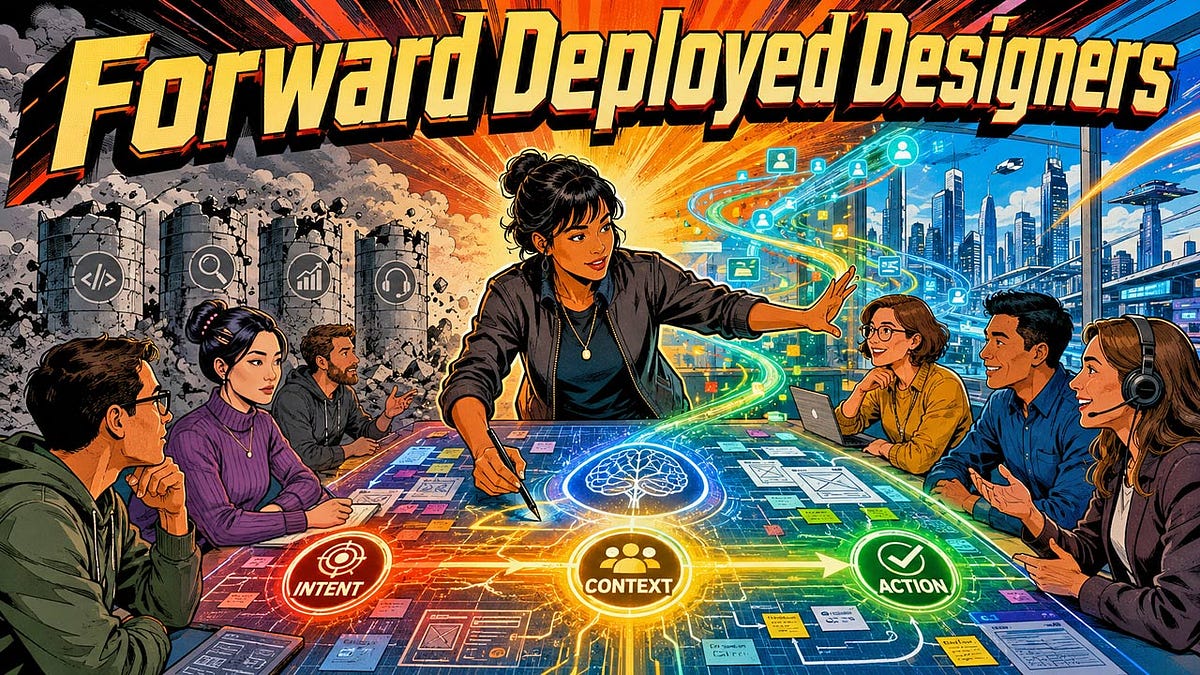
The Case for a New Design Discipline: Embedding in Organizations to Redesign Work Itself
Jakob Nielsen
As enterprise AI adoption stalls at incremental efficiency gains, a new practitioner role is proposed — one that sits at the intersection of service design, organizational psychology, and AI capability to eliminate obsolete workflows rather than just accelerate them. The argument is that technical deployment alone can't unlock transformation; someone must be embedded in operations, fluent in all three domains, to redesign work at a systemic level. For design leaders, this is a compelling reframing of design's organizational value — from aesthetic and interaction craft to structural intervention.
In the Feed
Four Plain-Text Rules That Push Claude's Coding Accuracy from 65% to 94%
AlphaSignal
A minimal configuration file — think before coding, simplify first, make surgical changes, verify goals — nearly doubles Claude's code generation accuracy, suggesting that structured intent-setting may matter more than model capability in AI-assisted workflows.

When AI Speaks in Probabilities, Humans and Models Don't Mean the Same Thing
Jakob Nielsen
A USC study finds that humans and LLMs interpret common probability language very differently — 'likely' means 66% to a human but closer to 80% to a model — a gap with real consequences when AI outputs feed high-stakes decisions in medicine, law, or design reviews.

AI Got More Capable This Week — But Who Actually Lost Ground?
Slow AI
A structured analysis of five AI developments — from mathematical breakthroughs to blocked police contracts and election misinformation — frames capability expansion as a power redistribution problem, asking who absorbs the costs of AI's gains in autonomy and scale.
Quick Takes
Endurance is becoming the new frontier of AI competition — systems that can run 35-hour autonomous tasks or hold a million-token context redefine what 'capable' means for design and knowledge workflows far more than benchmark scores do.
AlphaSignalThe biggest barrier to AI adoption isn't technical literacy — it's the psychological habit of not asking whether a tedious task could simply be abstracted away.
Lenny's Newsletter →DeepMind autonomously solving nine decades-old Erdős problems for a few hundred dollars in compute marks a genuine inflection: AI is no longer just an assistant to researchers, it is becoming a peer.
AlphaSignalStatic permission models were built for predictable actors — AI agents that plan dynamically and chain actions across systems require a fundamentally different authorization paradigm grounded in declared intent, not fixed identity.
Agentic AI →