The
Morning
Brief
Friday, June 5, 2026
Today's Signal
Today's content circles a central tension: AI is rapidly crossing from tool to autonomous actor, and the design disciplines that once owned the user experience layer are being forced to expand their scope or risk irrelevance. At the same time, the UX of AI itself—how users discover intent, how interfaces mediate probabilistic systems—is emerging as its own unsolved design problem. The structural question underneath all of it is whether human judgment remains meaningfully in the loop, or whether 'collaboration' is quietly becoming a polite fiction.
Deep Read

Design Is Now a Full-Stack Discipline — Whether Designers Are Ready or Not
Shape of AI
The clean abstraction of 'interface design' has collapsed under AI: the experience now emerges from a stack of interdependent layers — context, model behavior, governance, emergent properties — that designers have historically not owned or even seen. The piece argues that the shift from deterministic state-specification to probabilistic system design isn't optional; designers who ignore the layers beneath the surface will be designing for a system they fundamentally misunderstand. The implication for design systems work is profound — tokens and components are the visible tip of a much deeper iceberg.
In the Feed
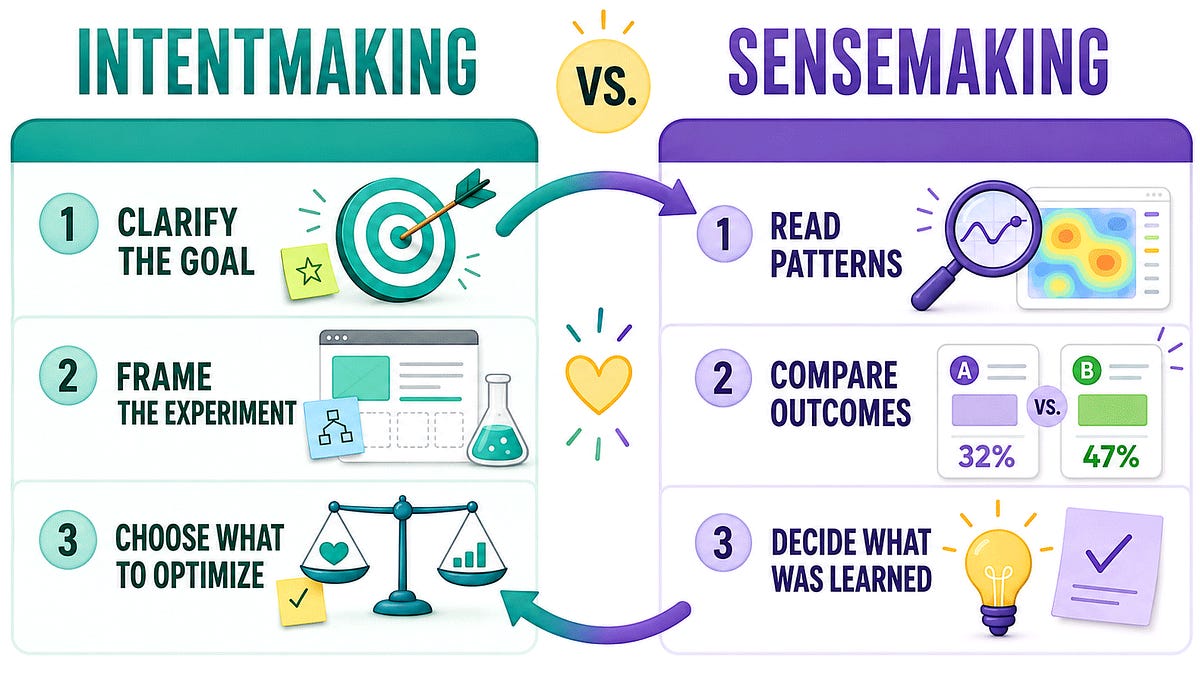
The Missing UX Primitive: How Humans Actually Work With Advanced AI
Jakob Nielsen
Research on expert users reveals that productive AI work isn't prompt-then-receive — it's a continuous loop of specifying, interpreting, and refining intent that the user themselves is still discovering. This reframes the AI interface challenge from 'making chat easier' to 'designing for structured discovery,' with boundary objects that translate between human expertise and machine output as the key missing ingredient.
The Co-Intelligence Era Is Ending — What Replaces It Is Harder
One Useful Thing
The comfortable mental model of AI-as-assistant is being obsoleted by agents that outperform humans on economically valuable tasks, with coding already at 80% AI-generated at some major tech firms. The challenge ahead isn't learning to prompt better — it's negotiating an ongoing, dynamic relationship with systems that are sometimes superior and sometimes unreliable, with no stable equilibrium in sight.
HeyGen's frame.md Wants AI Agents to Speak Fluent Brand
AlphaSignal
A new open spec extends the design.md pattern into video, giving AI agents a structured grammar for composing branded motion content — scenes, timing, and visual identity — rendered via headless Chrome to MP4. It's an early signal of how design systems thinking (tokens, specs, governed outputs) may need to extend into generative media pipelines.
Quick Takes
The most important design systems work of the next five years may not be in Figma — it will be in the specs, constraints, and governance layers that teach AI agents how to express brand and intent.
AlphaSignalPlatform self-regulation on AI-generated abuse material has failed by every measurable standard — 483 million downloads and $122 million in revenue for nudify apps that violate stated policies makes the gap between policy and enforcement impossible to ignore.
Slow AI →When Claude Code writes 17x more output than a human developer, the conversation about 'AI augmenting designers' starts to sound like motivated reasoning — the real question is what human judgment is uniquely irreplaceable for.
One Useful Thing →Designing AI UX as if users arrive with fully-formed goals is the field's most persistent and costly error — intent is discovered through the interaction, not before it.
Jakob Nielsen →