The
Morning
Brief
Thursday, June 4, 2026
Today's Signal
Today's pool circles a central tension: AI is accelerating execution dramatically while leaving the harder cognitive work — taste, judgment, strategy — unchanged and increasingly differentiated. Alongside that, the gap between what AI systems can do and what organizations and people are actually ready to absorb is emerging as the real constraint, not capability. For designers and design systems thinkers, this creates an unusual moment where deep craft knowledge becomes a structural advantage precisely as surface-level production gets commoditized.
Deep Read

AI Makes Ideation Cheap. It Makes Product Thinking No Easier.
Design Better Podcast
A technologist and writer argues that AI's most seductive quality — dramatically faster ideation — is also its most misleading promise. The hard work of product strategy, execution discipline, and knowing which ideas are worth pursuing remains stubbornly human-speed. In this moment, taste and judgment aren't soft skills to complement technical fluency; they're the actual bottleneck, and the people who've cultivated them will set the terms.
In the Feed
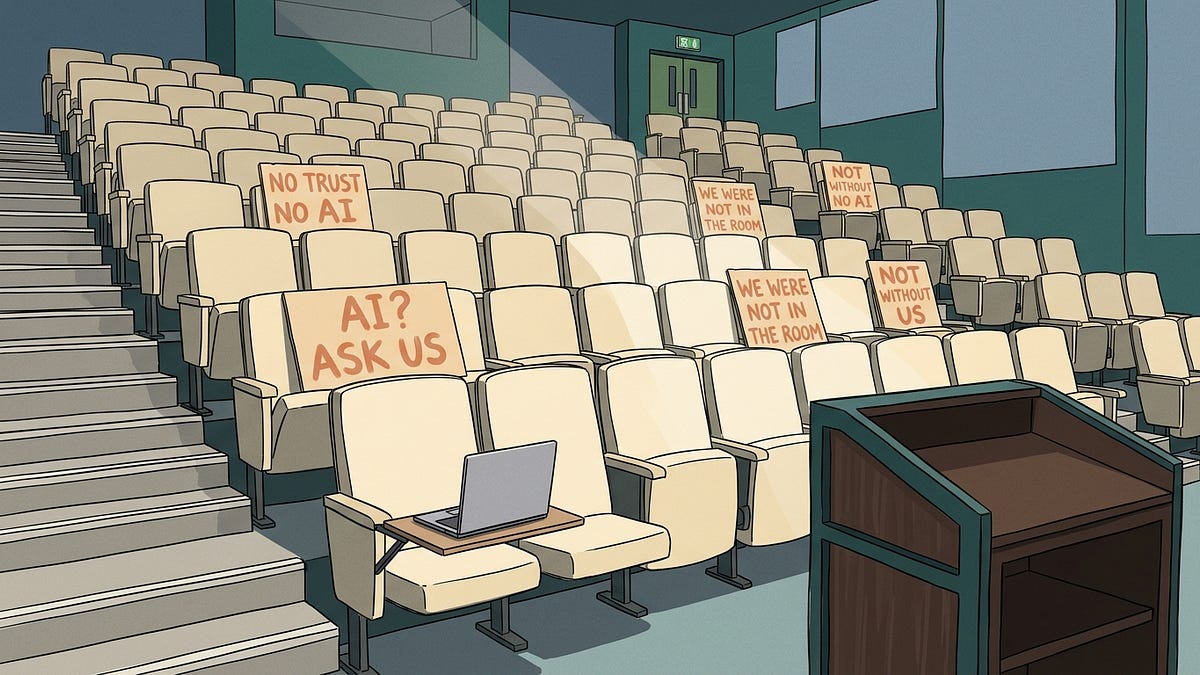
Students Are Opting Out of AI. The Instinct Is Right. The Strategy Is Wrong.
Slow AI
Gen Z's resistance to AI adoption is grounded in legitimate, research-backed concerns about cognitive offloading and displacement — but blanket refusal cedes the policy conversation to those who show up. Critical engagement beats principled absence when institutions are already making procurement decisions.

AI as Creative Collaborator: How a Designer Finally Shipped Their Own Portfolio
Design Better
A firsthand account of using AI to break through the specific creative paralysis that hits designers when the client is themselves. Beyond the personal story, the piece surfaces practical principles: let the work dominate, minimize explanatory scaffolding, and treat AI as a thinking partner rather than a generator.

From Prompt to Goal: The Mental Model Shift That Makes Agentic AI Actually Useful
Lenny's Newsletter
Codex's Goals framework draws a sharp line between telling an AI what to do and defining what a good outcome looks like — the latter enables autonomous multi-step work without constant intervention. For anyone thinking about how agentic workflows will reshape design and knowledge work, this is the architectural concept worth internalizing.
Quick Takes
Sam Altman walking back near-term job displacement predictions isn't humility — it's evidence that the gap between technical capability and real-world adoption velocity is the actual story of AI's impact on work.
The Founders Corner →The abliteration research is a design systems problem in disguise: safety behavior is a fragile implementation detail, not a structural property, and open-weight models have no governance layer to enforce it at runtime.
Agentic AI →OpenAI's Codex Sites — describe an app, get a live hosted URL — is the clearest signal yet that the distance between design intent and deployed artifact is collapsing, and what that means for design systems pipelines deserves urgent attention.
AlphaSignalLLMs failing at spelling because they process token patterns rather than characters is a useful reminder that fluency and accuracy are orthogonal properties — a distinction every designer using AI for copy or content should keep front of mind.
The Founders Corner →