The
Morning
Brief
Tuesday, June 23, 2026
Today's Signal
Today's content circles a central tension: AI is rapidly capable enough to replace routine creative and technical execution, but the advantage now belongs to those who build smarter workflows around it rather than those who simply use it. Whether it's designers using inspect tools to direct AI code changes, agents rewriting their own skill files, or the finding that AI-generated UIs are usable but emotionally flat, the signal is consistent — human judgment and craft still determine the ceiling, even as AI raises the floor.
Deep Read

AI Designs Are Functionally Solid but Emotionally Hollow — and That Gap Is the Designer's New Territory
Jakob Nielsen
A rigorous study finds AI-generated interfaces match human designs on usability and task efficiency, but consistently underperform on hedonic and emotional dimensions — the qualities that make products feel considered rather than competent. This happens because AI training data skews toward established patterns, making it a strong executor of convention and a poor generator of distinction. The real strategic insight: the AI's ability to produce many design variants cheaply changes the game when selection is guided by actual testing rather than visual preference.
In the Feed
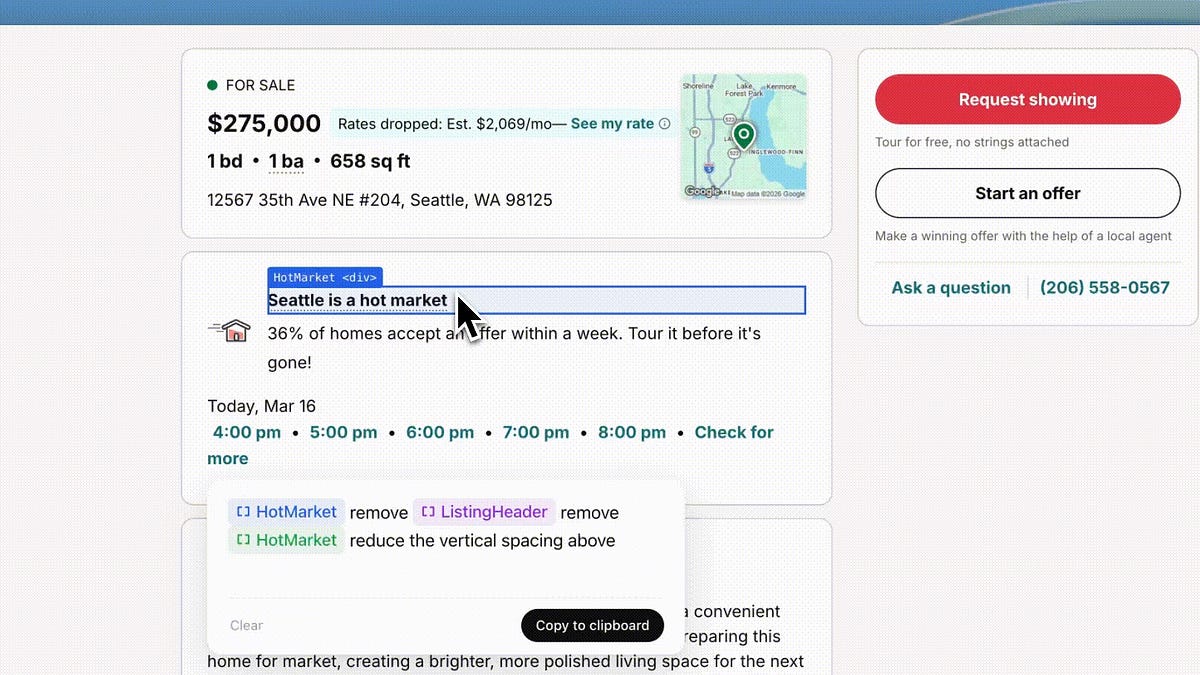
A Designer Built a Browser Inspect Tool for Claude Code — and It Points to How Design Workflows Are About to Change
Design with AI
By wiring browser DevTools directly into an AI coding session, the friction of translating visual intent into code instructions collapses: click an element, request the change, skip the screenshots and verbal approximations. This is a concrete preview of how designers might direct implementation without fully leaving their visual context.
Agents That Rewrite Their Own Instructions Are a Quiet Shift in How AI Systems Mature
AlphaSignal
Rather than manually tuning the markdown skill files that define agent behavior, new optimization frameworks treat those documents as trainable parameters — automatically iterating, validating, and evolving agent instructions through feedback loops. For anyone building AI-assisted workflows, this suggests the operational overhead of maintaining agent behavior may soon compress dramatically.

Brooks's Law Is Dead — AI Replaces Headcount with Compute, and That Reshapes Every Team
Jakob Nielsen
The old rule that throwing more people at a late project makes it later no longer holds when the resource is compute rather than coordination overhead. The implication for design and product teams is structural: the constraint on output is shifting from human capacity to infrastructure access, concentrating advantage in well-resourced organizations.
Quick Takes
AI-generated UI is a strong first draft but a poor final answer — it gravitates toward the statistically average solution, which is exactly what brand differentiation and emotional resonance work against.
Jakob Nielsen →The most durable competitive moat in AI products isn't the model — it's the accumulated institutional knowledge and human judgment layered on top of it.
The Founders Corner →A physical Stream Deck as a control panel for AI coding sessions is a strange but telling signal: as AI agents multiply, the interface for managing them becomes its own design problem.
AlphaSignalAs open-weight models close the capability gap with frontier labs, the battleground shifts to the applied layer — the design systems, workflows, and integrations built on top, not the models underneath.
Big Technology