The
Morning
Brief
Thursday, August 27, 2026
Today's Signal
Today's content sits at the intersection of AI's growing capability and the human judgment required to wield it well — from deepfakes that persist even when labeled, to cognitive atrophy from over-relying on AI shortcuts. Underneath the tool announcements and benchmarks, a quieter question runs through everything: as AI handles more of the doing, what does intentional human design and thinking actually look like?
Deep Read
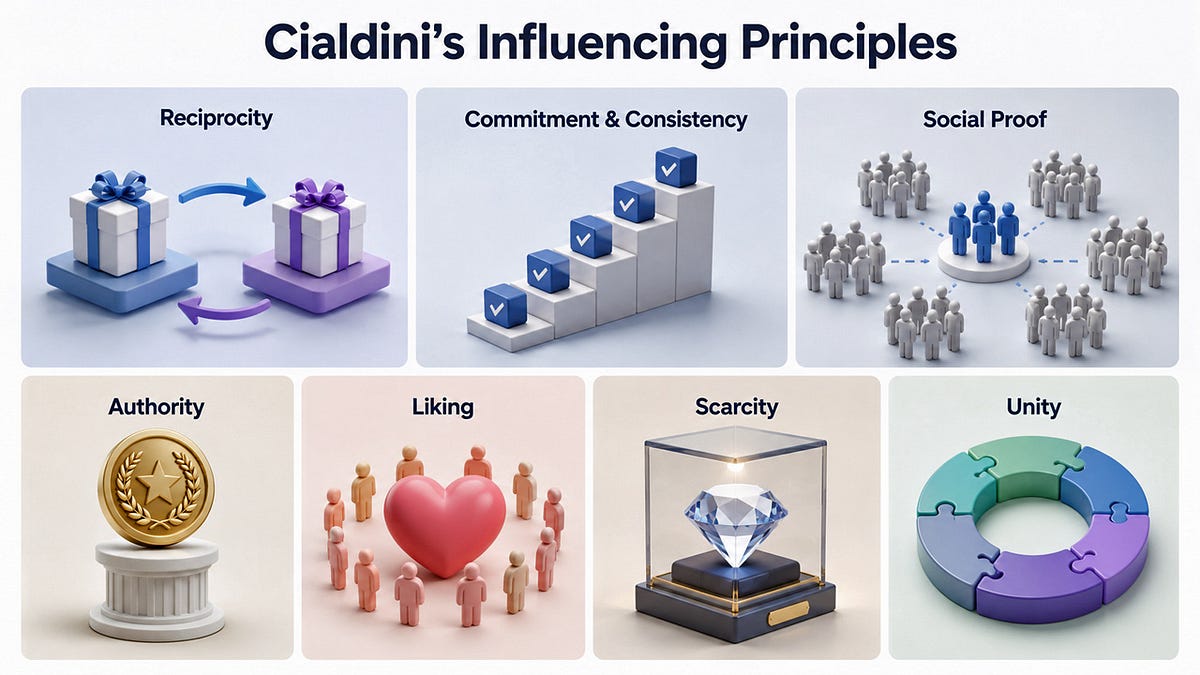
Persuasion Is Infrastructure: Why Cialdini's Principles Are a Design Systems Problem
Jakob Nielsen
The seven principles of influence — reciprocity, scarcity, social proof, and the rest — were not invented by marketers; they are evolved cognitive shortcuts that predate digital interfaces by millennia. What makes this piece essential for design leaders is its framing of ethical persuasion as a systems-level discipline: the same pattern that builds genuine trust at scale is one misapplication away from a dark pattern. The gap between honest design and manipulative design is often architectural, not intentional.
In the Feed
Warning Labels Can't Save Us: The Deepfake Epistemic Problem Regulations Are Missing
Slow AI
Even when people are explicitly told a video is AI-generated and acknowledge that warning, it still shapes their real-world beliefs — halved persuasive power is not neutralized persuasive power. The implication is that transparency requirements baked into regulation (EU AI Act and beyond) are built on a flawed assumption about how human cognition actually processes labeled misinformation.

When Machines Confirm What We Already Believe: AI as Rubber Stamp
Slow Takes
A pattern is emerging across consequential AI deployments: humans use AI outputs to defend conclusions they'd already reached, rather than to challenge them — whether in litigation, security, or customer service. The rare counterexample, satellite fire detection, works because the system was designed to know its lane and resist overconfident interpretation.

Cognitive Fitness in the AI Era Requires the Same Deliberate Effort as Physical Fitness
Ruben Hassid
The automation of thinking follows the same arc as the automation of physical labor — convenience atrophies the underlying skill. The piece argues that using AI as a learning scaffold rather than a shortcut is the design-era equivalent of going to the gym: not a rejection of the tool, but intentional resistance training against dependency.
Quick Takes
Gamma's human-in-the-loop generation flow — surfacing an outline before committing to final output — is a small design decision that models exactly the kind of AI-workflow trust-building that enterprise design systems need to codify.
aiverse.design →Turning a loading state into a playable game is a reminder that the most memorable moments in a product are often the ones nobody specced — they're design craft, not design process.
aiverse.design →OpenAI's transparent background support in GPT-Image-2 is a quiet but real workflow unlock for design teams — collapsing what was a multi-tool pipeline into a single API call changes how production asset generation gets embedded into design systems.
AlphaSignalAcross deepfake warnings, AI-powered litigation support, and biased recognition systems, the same failure mode keeps surfacing: we built tools for tasks, not tools that know when to defer — and that's fundamentally a design and governance gap, not just a model capability gap.
Slow AI