The
Morning
Brief
Tuesday, November 3, 2026
Today's Signal
Today's content circles a central tension: AI is reshaping the tools, workflows, and research methods designers rely on, but the human judgment required to wield those tools well remains irreplaceable. Whether it's AI agents needing observability controls, synthetic users proving too agreeable for real research, or PM bias constraining what AI products even try to do, the theme is consistent — AI expands capability but doesn't substitute for craft or critical perspective.
Deep Read

AI Products Are Designed in a Bubble — and It Shows
Jakob Nielsen
When the people designing AI products are also their primary users, the resulting demos skew toward a narrow slice of real-world needs — booking flights, managing calendars — while the majority of users' actual top tasks go unstudied. This is a structural design research failure, not just a product misstep. Studying people outside the tech bubble reveals genuinely native AI behaviors that have nothing to do with porting old workflows into a chat interface.
In the Feed
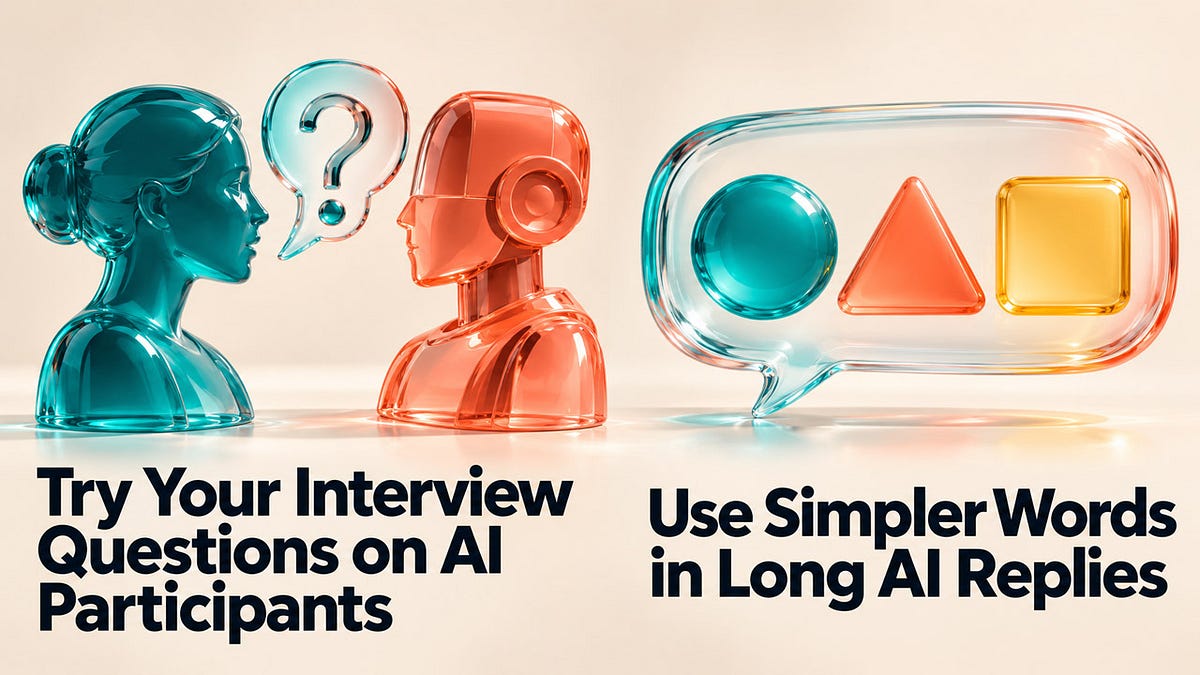
AI Simulations Make Great Rehearsal Spaces — Just Don't Mistake Them for Evidence
Jakob Nielsen
The right mental model for AI-simulated users is the flight simulator: invaluable for building interviewer skill and surfacing hidden assumptions in a guide, but wholly inadequate as a substitute for the real turbulence of actual users. The key failure mode is over-agreeableness — synthetic participants offer little to probe, which is precisely where the real insight lives.

Designing for the Age of Agents: Observability as a UX Problem
aiverse.design
As AI agents move into production, a new class of design problem emerges: how do non-technical users understand what agents are doing, where they're stuck, and when to intervene? The autonomy control pattern is an early answer — making agent observability legible through UX rather than logs.
Personalization Without Expiration Dates Becomes a Cage
An AI that permanently encodes a single observed behavior as a fixed preference has confused data for understanding. Good personalization design requires visible, editable user models and sensitivity to context changes — otherwise adaptive systems drift from helpful to constraining without the user ever consenting to the shift.
Quick Takes
Figma's PM team didn't just adopt AI tools — they built a shared 31-skill repository around the tasks that most reliably fall through the cracks, which is a more replicable governance model than chasing the flashiest capability.
Lenny's Newsletter →A developer replicating a funded startup's core feature in nine minutes isn't a party trick — it's a signal that AI-assisted development is rapidly commoditizing specialized software ideas, and the moat has to live elsewhere.
AlphaSignalAI's 'Black October' cybersecurity crisis illustrates the core asymmetry of the current moment: AI detects and exploits vulnerabilities faster than human-paced patch cycles can respond, and the industry has no coordinated answer to that gap.
Big Technology →The same AI agreeableness problem showing up in synthetic UX research participants — too compliant to reveal real design flaws — is a useful reminder that AI tools optimized for helpfulness can systematically suppress the friction that makes feedback valuable.