The
Morning
Brief
Thursday, November 5, 2026
Today's Signal
Today's content sits at the intersection of AI's growing structural role and the craft disciplines it's reshaping — from how interfaces must respect deep user expectations to how autonomous agents are redefining what 'doing work' even means. The clearest throughline is that AI doesn't just accelerate existing workflows; it raises the stakes for decisions that were always important, whether that's UX convention, design system discipline, or the reliability of the systems we build on top of probabilistic models.
Deep Read

The Expectation Economy: Why AI Makes UX Convention More Important, Not Less
Jakob Nielsen
Users arrive pre-trained by billions of prior interface exposures, and seven interlocking principles — from Jakob's Law to MAYA — explain why designs that respect mental models outperform those that challenge them. The counterintuitive implication for the AI era: as interfaces become more conversational and agentic, the cost of violating user expectations doesn't shrink, it compounds. For designers building AI-native products and design systems that govern them, this is a foundational reframe — novelty is a liability unless carefully earned.
In the Feed

Building Fast Is Easy — Knowing What to Build Is the Hard Part
Unprofessional
A solo-built AI product revealed that speed of development can mask fundamental product errors; the real onboarding problem wasn't missing features but premature permission requests, only discoverable through behavioral data and direct conversation. It's a sharp reminder that AI-assisted build velocity demands proportionally more rigor around validation, not less.

Four Personal AI Agents, Nine Tasks, No Clear Winner
Lenny's Newsletter
A head-to-head benchmark of leading personal AI agents finds that task category matters more than model reputation — professional work, personal tasks, and speed requirements each favor different tools. For designers evaluating AI in their own workflows, the takeaway is that agent selection should be contextual, not tribal.
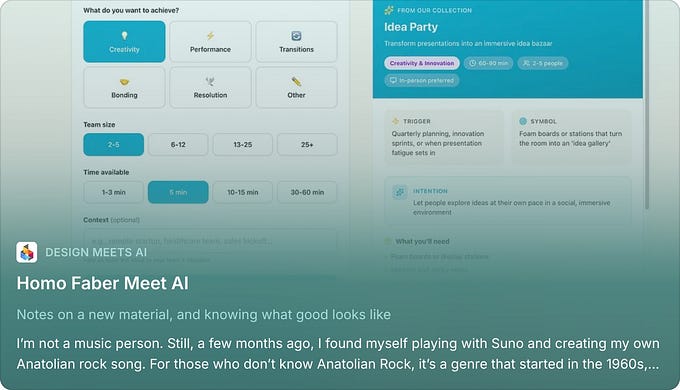
Toolmaking as an Ancient Impulse: AI Is Just the Latest Chapter
Substack
Framing today's AI-driven tool creation within humanity's 2.6 million-year history as toolmakers recontextualizes the current moment — not as rupture, but as the latest expression of a defining human drive. It's a useful philosophical anchor for creative professionals trying to locate themselves in a rapidly shifting landscape.
Quick Takes
The chatbar pattern — blending search and conversational AI — is quietly becoming the dominant UI primitive of this product cycle, and design systems that don't account for it yet are already behind.
aiverse.design →A multi-agent AI lab autonomously ran quantum physics experiments and discovered a new physical law — a signal that AI's impact on knowledge work is no longer theoretical or incremental.
AlphaSignalA counterfeit AI dev tool distributed via VS Code's marketplace installed backdoors on 5,000 machines — the supply chain attack surface is expanding exactly as fast as AI tooling adoption.
AlphaSignalThe gap between building fast and building right is widening: AI tools lower the floor on execution effort, which makes product judgment — not velocity — the scarce and differentiating resource.
Unprofessional