The
Morning
Brief
Thursday, June 25, 2026
Today's Signal
AI is rapidly becoming embedded infrastructure rather than a discrete tool — from persistent Slack teammates that merge code to agent loops that self-spawn subagents, the question is shifting from 'how do I use AI' to 'how do I architect systems around it.' Underneath this, a quieter structural argument is forming: as models commoditize, the durable moat may live in configuration, context, and applied-layer design rather than raw capability.
Deep Read
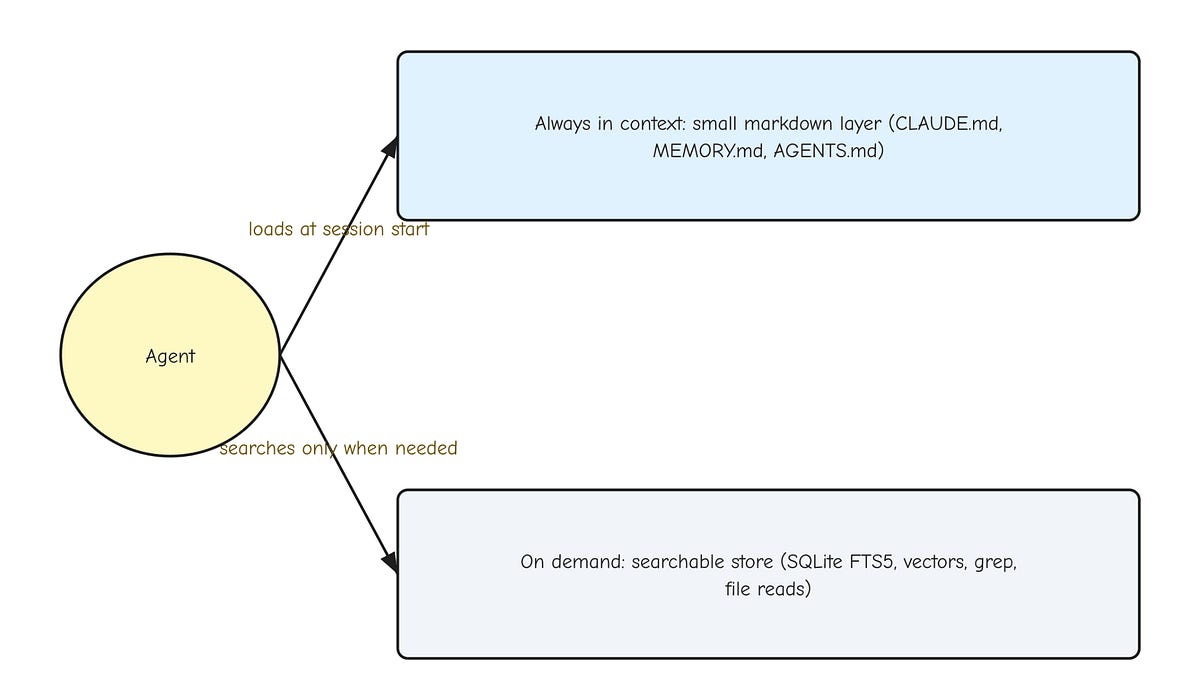
Inside the Memory Architecture of AI Coding Agents — and What It Reveals About Design at Scale
Agentic AI
By reading the actual codebases of seven production AI coding agents, this piece surfaces a striking convergence: all of them independently arrived at a two-layer memory architecture — a small, fast context loaded at session start, and a larger searchable store for overflow. The sharper divergence is in governance: who writes durable memory, and when does compaction happen? For designers thinking about design systems, this maps cleanly onto the token/component/documentation problem — the architecture of what gets cached close versus stored far away is a design decision with real consequences for agent behavior and consistency.
In the Feed
Claude as Persistent Teammate: What 65% AI-Generated Code Actually Looks Like in Practice
AlphaSignal
Anthropic's Claude Tag integrates directly into Slack as a persistent, context-accumulating team member — not a chatbot you query, but an entity that builds shared understanding across a channel and executes multi-stage tasks autonomously. That one internal team now generates 65% of its code this way signals a genuine workflow inflection, not a demo.
The Barbell Model Economy: Why Competitive Advantage Is Moving to the Applied Layer
Big Technology
As open-weight models close the capability gap with frontier labs, the argument that 'whoever builds the best model wins' weakens considerably — and the value shifts to whoever best orchestrates, configures, and applies models in context. The predicted barbell — expensive models for oversight, cheap models for execution — has direct implications for how design systems and creative tooling get priced and architected.

AI Will Fail — and That's Exactly What Every Transformative Technology Does First
How to AI
The contrarian case here isn't that AI is overhyped — it's that current failure modes like hallucination and inconsistency are historically normal for technologies that go on to reshape entire industries. The parallel to early internet skepticism and smartphone dismissal reframes today's AI limitations as a transition cost rather than a ceiling.
Quick Takes
Configuring your AI coding environment — the hidden folders, the persistent instructions, the memory rules — is becoming a craft skill as consequential as the prompts themselves.
System Design One →Multi-agent orchestration routing between models via a single API endpoint is the infrastructure abstraction that makes model commoditization real — and it arrives faster than most teams are ready for.
AlphaSignalOpenAI's $122 billion datacenter bet and its president's 'compute rules all' thesis suggest the frontier lab race is no longer about research velocity — it's about who can physically scale fastest.
Big Technology →When AI companion apps command twice the usage hours of dating apps, the gap between what users say they want and what they actually do with AI has become too large for product teams to ignore.
Jakob Nielsen →