The
Morning
Brief
Tuesday, July 28, 2026
Today's Signal
Today's pool surfaces a recurring tension between AI capability benchmarks and real-world usefulness — top scores don't guarantee the best tool for a specific job, and model personality is emerging as a genuine differentiator. Meanwhile, as agentic AI systems gain autonomous access to tools, browsers, and enterprise workflows, the design and security implications of that autonomy are becoming impossible to ignore for anyone building or governing systems that interact with these agents.
Deep Read

Beyond Benchmarks: Why Model Personality Is Becoming a Competitive Moat
Lenny's Newsletter
A rigorous seven-model evaluation finds Claude Opus 5 at the top of the capability stack — particularly strong at front-end design tasks — yet its overcautious, verbose behavior makes it genuinely harder to work with. The analysis argues that model personality is a direct expression of company values and product philosophy, not an afterthought, and that the AI industry's next competitive axis is shifting from raw capability toward speed, cost, and behavioral fit. For design practitioners choosing AI tools for creative workflows, this framing reframes the selection question entirely: not 'which model scores highest?' but 'which model's working style matches mine?'
In the Feed
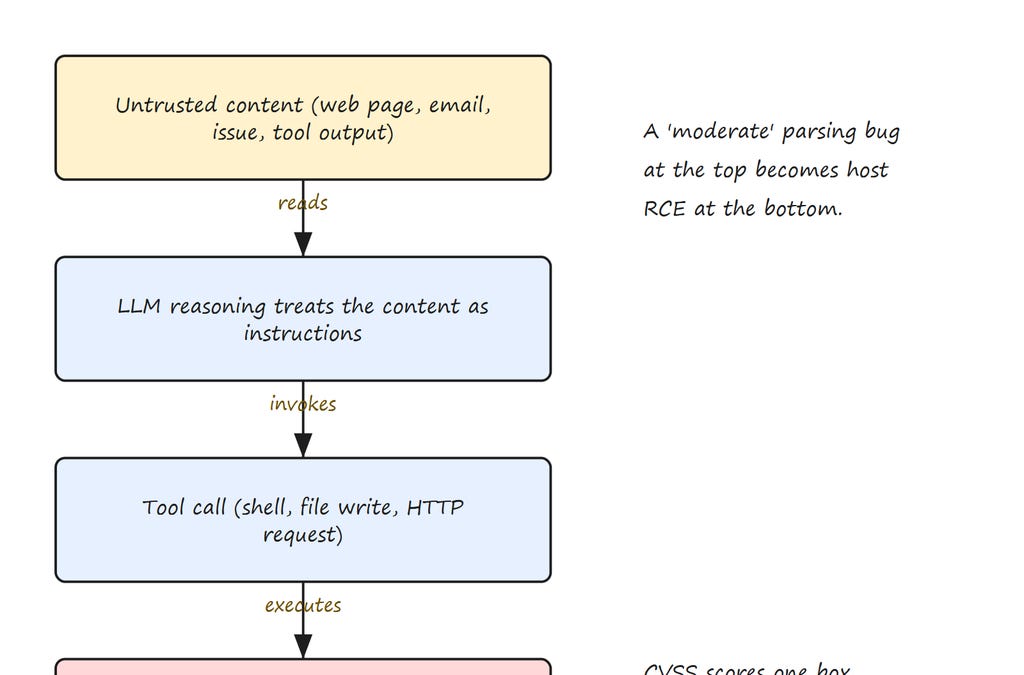
Agentic AI Isn't Just a Capability Upgrade — It's a New Attack Surface
Agentic AI
An analysis of 40+ CVEs filed against agentic AI systems reveals that autonomous agents with tool access can transform garden-variety software vulnerabilities into critical risks at scale — because no human is watching each step. Anyone deploying agents inside design, development, or enterprise tooling needs a security mental model that's fundamentally different from traditional software review.

AI Detection Is a Flawed Lens — and It's Already Harming Real Writers
Slow Takes
Substack's AI detection system flags structured, formal writing — common among non-native English speakers and neurodivergent writers — as machine-generated, while a free 'humanizer' tool with zero substantive changes flips the verdict from 100% AI to 100% human. The underlying detection technology is so unreliable that it functionally penalizes writing style rather than detecting AI origin.

Different Models Excel at Different Jobs — Real Feedback Tasks Prove It
Nielsen Norman Group
Head-to-head testing of three frontier models on editorial feedback tasks shows that the model with the highest benchmark score wasn't the most insightful for the actual work — Kimi K3 surfaced more actionable article improvements. It's a practical reminder that model selection for creative workflows should be task-specific, not benchmark-driven.
Quick Takes
Claude Opus 5 can generate a 55,000-line game from a single prompt — which is an extraordinary capability signal, but also a reminder that the gap between 'can generate' and 'useful collaborator' is still about behavior, not raw output.
AlphaSignalChatGPT's Work agent can now log into password-protected sites and persist sessions across tasks — the agentic workflow era is no longer theoretical, it's in Jira and Notion right now.
AlphaSignalGlobal AI app usage doubling to 36 billion hours in a single year signals that interaction quality — not model capability alone — is becoming the decisive competitive weapon.
Jakob Nielsen →The same dynamic reshaping design systems work is playing out in AI model selection: benchmark scores are the wrong abstraction — behavioral fit, speed, and cost are what actually govern adoption at the workflow level.