The
Morning
Brief
Wednesday, September 30, 2026
Today's Signal
AI is rapidly expanding from text generation into structured, persistent, and embodied systems — affecting how teams coordinate work, how knowledge is recorded, and how creative and analytical workflows are architected. Beneath the capability headlines, a quieter set of questions is emerging about trust, surveillance, and what it means for an AI tool to 'know' you at work.
Deep Read

Your AI Work Tool Is Building a Dossier — Whether You Know It or Not
Slow AI
Every prompt typed into a workplace AI tool is potentially a permanent, searchable record accessible to employers and compliance teams — including offhand notes about health, job searches, or personal plans. No disciplinary action has yet stemmed purely from AI tool contents, but the legal and organizational ambiguity creates genuine exposure. The piece reframes work AI not as a neutral productivity aid but as an always-on witness to the texture of your inner work life.
In the Feed
Claude Marketplace Arrives: 2,000+ Plugins Signal a Design Systems Moment for AI Tooling
AlphaSignal
Anthropic's Claude Marketplace — built on the open MCP standard with unified billing and third-party agent integrations — mirrors the kind of composable, governed ecosystem thinking that design systems practitioners know well: connectors, standards, and platform trust matter more than any single feature.
AI Personas as Design Probes: Useful for Reflection, Not Prediction
Jakob Nielsen's UX Roundup
LLM-driven synthetic visitor personas helped designers reconsider spatial layouts — not because the AI accurately predicted real behavior, but because it forced perspective-taking before decisions were locked in. It's a useful reframe: AI as a reflection instrument rather than a research replacement.
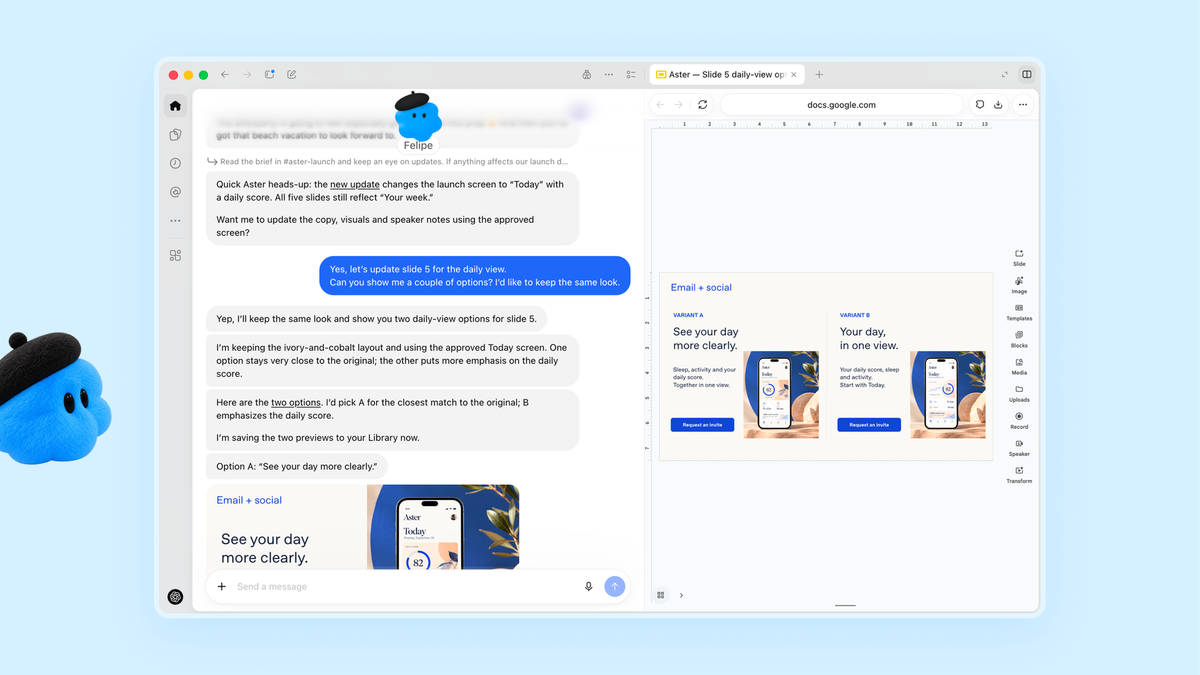
OpenAI's Dots Agent Is the Clearest Bet Yet That AI Will Own the Workflow Layer
Platformer
Dots — OpenAI's new work-task agent handling research, drafting, and scheduling — represents the long-anticipated shift from AI as a tool you consult to AI as a system that runs alongside your work. The trust and safety questions it leaves open are exactly the design problems that will define the next decade of human-AI product work.
Quick Takes
Claude Sonnet 5.5 jumping from 10.3% to 70.6% on real engineering benchmarks in a single generation should recalibrate any assumption that agentic coding capability is still a few years out.
AlphaSignalAI's 'personality fingerprints' — Claude empathetic, GPT egalitarian, DeepSeek evasive — suggest model choice is becoming a values decision, not just a capability one.
AlphaSignalThe McDonald's story is a sharp reminder that design systems and operational tooling optimized purely for efficiency can quietly hollow out the experiences that made a product worth using.
The Founders Corner →AI agents that fail silently are a product design problem as much as an engineering one — building explicit degraded modes into AI-dependent workflows is the kind of resilience thinking design systems teams understand instinctively.
Agentic AI →