The
Morning
Brief
Tuesday, November 10, 2026
Today's Signal
Today's content circles a central tension: AI is demonstrably outperforming humans on creative and knowledge tasks, yet the systems delivering that performance have jagged edges — blind spots, security gaps, and workflow debt that require human judgment to manage. For design and creative leaders, the signal is that AI fluency is becoming a structural advantage, not just a productivity tool, with the question shifting from 'can AI do this?' to 'who controls the workflow context that makes AI outputs valuable?'
Deep Read

The 'Jagged AGI' Problem: When AI Excels at Everything Except Knowing Its Own Limits
One Useful Thing
Claude's latest model demonstrates extraordinary capability across hardware hacking, academic research, and creative world-building — yet consistently fails to recognize when its own output is repetitive, incomplete, or aesthetically off. This 'Jagged AGI' pattern has direct implications for creative workflows: designers and directors can't simply hand off judgment to a model that can't evaluate the quality of its own work, meaning the human role may be shifting from maker to discerning critic and quality arbiter.
In the Feed
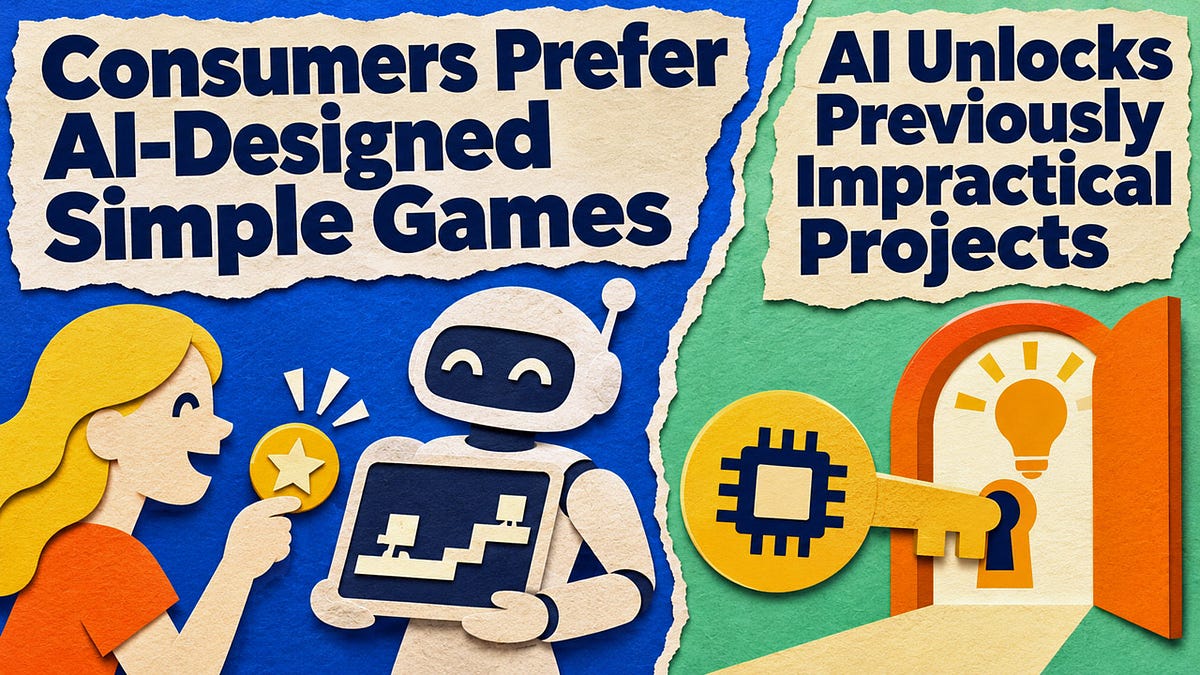
AI-Designed Games Outperformed Professionals by 27% — and Nobody Cared Who Made Them
Jakob Nielsen's UX Roundup
In a controlled market experiment, AI-generated game designs beat both amateur and professional human designers, and disclosing human authorship had zero effect on willingness to pay — a data point that should land hard for anyone whose creative value proposition rests on craft provenance alone.

Figma's Internal AI Playbook: A Shared Skill Repo and an Automated Experiment Agent
The Founders Corner
Figma's product org built a shared repository of 31 AI skills now running across 60+ PMs, plus an autonomous experiment agent that runs growth tests with a single human checkpoint — a concrete model for how design and product orgs can operationalize AI as institutional infrastructure rather than individual productivity hacks.
Workflow Ownership Is the New Moat: How AI Applications Hold Pricing Power
The Founders Corner
As foundation models commoditize, the analysis finds that AI applications retain leverage through three things: control of the user workflow, embedded context competitors can't replicate, and measurable value beyond token usage — a framework that maps directly onto how design systems and tools create defensible organizational value.
Quick Takes
The most important creative skill in an AI-augmented world may be aesthetic judgment — the one thing current models demonstrably can't self-evaluate.
One Useful Thing →If AI can generate more detailed creative direction from a single prompt than three rounds of human feedback, the value of a creative director shifts decisively toward taste, curation, and knowing when to override the output.
Jakob Nielsen's UX Roundup →Demo Kitchen's AI-driven screen recording and export tool is a small but telling example of the pipeline collapsing: tasks that once required a dedicated motion designer are becoming a prompt.
Design with AI →The real leverage in AI-assisted work isn't the tool — it's the shared context repository that makes the tool smarter for everyone on the team, which is essentially what design tokens and systems have always been about.
The Founders Corner